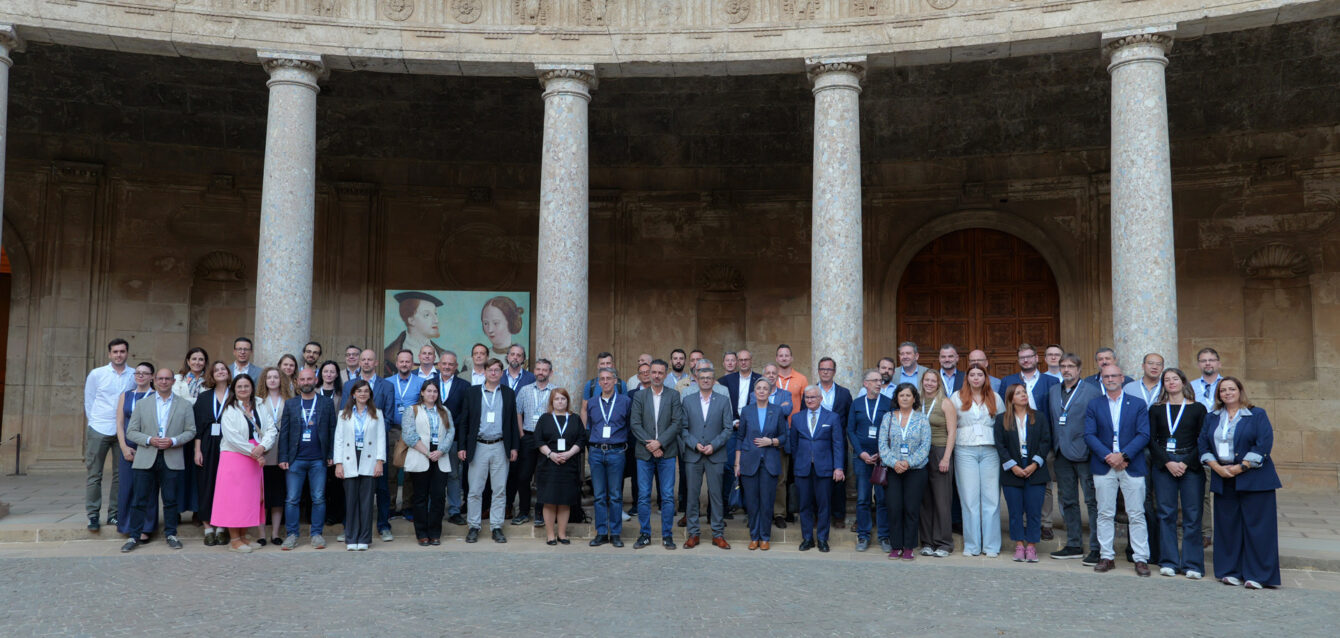
Leaders from across Europe met to discuss how AI in public services can stay trustworthy, controllable and at the service of citizens.
Granada, 28 October 2026. EUNOMIA.AI, the European project helping public administrations use generative AI (GenAI) to improve services for citizens, officially launched in Granada on 26 – 27 October. The project is co-funded under the EU’s Digital Europe Programme, with a total budget of €13.99 million, half of it contributed by the European Union. It brings together 33 organisations from 14 countries.
The project started on 1 July 2026 and runs for three years, until 30 June 2029. Its launch in Granada took place during the project’s first General Assembly, where partners met in person to discuss the technology, the use cases and the rules that will shape the pilots.
What EUNOMIA.AI will do
EUNOMIA.AI will support public administrations as they introduce GenAI-powered applications and services into their day-to-day work. The aim is to bring GenAI tools to 25 public administrations and into at least 15 public services, reducing time spent on repetitive tasks and improving the service experience for citizens.
The tools are built on open-source European technology, which means their code is openly available for others to check and reuse. They are designed to comply with the EU AI Act and GDPR. They are co-developed with the public administrations that will eventually be using them, and run on a shared GenAI infrastructure hosted at the University of Granada.
Areas where GenAI will become useful
The pilots will cover four areas. Examples of what they may include:
- Administrative processes: AI tools that support document analysis, procurement and preparing decisions, so routine processes become simpler and take less time.
- Law as code: AI tools that explain regulations in simple language and make legal and administrative content easier to interpret and apply.
- Virtual assistance: multilingual AI assistants that answer questions from citizens, businesses and public employees, for example about public services, funding opportunities or internal procedures.
- Multimodal automation: AI tools that process documents, audio and images together, for example by transcribing recordings or classifying incoming files, to streamline complex administrative work.
The pilots will be selected and designed over the coming months, with the first expected to go live in 2027.
Two days in Granada
The General Assembly, bringing together partners from all 14 countries, was hosted by the Digital Agency of Andalusia (ADA), the project coordinator. The programme opened on 26 October at the Andalusian Centre for Artificial Intelligence (ANIA). ANIA is the body through which the Regional Government of Andalusia coordinates the introduction of artificial intelligence and quantum computing across its administration. This is one of the reasons Granada was chosen to host the launch.
At ANIA, the project’s brand was presented, including the logo and design elements that will accompany EUNOMIA.AI across Europe, and the project website. Partners then moved to Alhambra for the General Assembly, which was addressed by Ana María Corredera Quintana, Deputy Regional Minister for Artificial Intelligence, Digital Development and Public Administration of the Government of Andalusia. Partners reviewed the project roadmap and discussed the next steps and the implementation plan for the months ahead.
On 27 October, working sessions at the Palacio de Congresos reviewed progress on the use cases and the technical work behind them. Partners also looked at regulation, compliance and security, including how each pilot will meet the requirements of the AI Act.
IV Congress of Artificial Intelligence of Andalusia
From 26 to 28 October, ADA is also hosting the IV Congress of Artificial Intelligence of Andalusia at the Palacio de Exposiciones y Congresos de Granada.
Recognised by the European Commission as a partner event of the European AI Innovation Month, the Congress brings together public officials, researchers, companies, start-ups and students. Its programme ranges from AI in public administration and European AI infrastructure to safe AI, healthcare and cybersecurity.
On 27 October, partners joined the Congress, where the experts leading each area of EUNOMIA.AI took part in the round table “EUNOMIA.AI – Building European Public AI”, in the main hall. Between them, they cover the project’s full path, from the first concept to AI tools in everyday use: technical development, AI safety and compliance, infrastructure, the pilots, impact and communication.
Moderated by Manuel Escobar Montes, Deputy Director for Digital Services and Data Analytics at ADA, the round table brought together:
- Panos Louridas, Director of Research and Development, GRNET (Greece)
- Szymon Łukasik, Director of AI Safety, NASK (Poland)
- Gabriel Maciá Fernández, Vice Rector for Digital Transformation, University of Granada (Spain)
- Jānis Ziediņš, Deputy Director for Digital Development, Culture Information Systems Centre – KISC (Latvia)
- Stefan Thalmann, Director of the Center for Data Science in Business and Society (BANDAS), University of Graz (Austria)
- Artemis Psarianou, Head of the Marketing and Communications Department, GRNET (Greece)
They presented the project’s vision, its objectives and the impact it is expected to have on public services across Europe, and on how citizens experience them.
“Public administrations across Europe hold deep expertise in delivering the public services citizens depend on. Generative AI offers a real opportunity to strengthen that work, freeing time for what matters most and giving citizens clearer, faster services. Yet this potential can only be realised if the technology earns public trust. EUNOMIA.AI is therefore built on open European technology, designed in accordance with the AI Act and the GDPR, and developed hand in hand with experts from public administrations. Our goal is clear: to improve public services for every citizen in Europe.”
Manuel Escobar Montes, Deputy Director for Digital Services and Data Analytics, Digital Agency of Andalusia, EUNOMIA.AI project coordinator
Follow EUNOMIA.AI: eunomia-ai.eu • LinkedIn • YouTube
Media kit
Photographs from Granada are available on request from the media contact below.
Media contact
Artemis Psarianou, GRNET • marcomms@admin.grnet.gr
Notes to editors
About EUNOMIA.AI
EUNOMIA.AI is a three-year European project co-funded under the Digital Europe Programme. It brings together 33 organisations across 14 countries to help public administrations adopt generative AI (GenAI), so that public services become faster, simpler and better for citizens. The project is built on open-source European technology and designed to comply with the AI Act and the GDPR from day one.
- Funding programme: Digital Europe Programme
- Budget: €13.99 million, 50% contributed by the European Union
- Duration: Three years, 1 July 2026 to 30 June 2029
- Consortium: 33 organisations in 14 countries: Austria, Estonia, Finland, Germany, Greece, Hungary, Italy, Latvia, Malta, the Netherlands, Norway, Poland, Portugal and Spain
- Coordinator: Digital Agency of Andalusia (ADA), Spain
- Website: eunomia-ai.eu
Consortium partners
- Austria: Federal Ministry of Agriculture and Forestry, Climate and Environmental Protection, Regions and Water Management; City of Wels; City of Graz (associated partner); University of Graz
- Estonia: Ministry of Justice and Digital Affairs
- Finland: City of Tampere
- Germany: Humboldt-Universität zu Berlin; STELAR Security Technology Law Research UG
- Greece: Waste Management of Western Macedonia (DIADYMA SA); Cluster of Bioeconomy and Environment of Western Macedonia (CluBE); National Infrastructures for Research and Technology (GRNET); Ministry of Digital Governance (associated partner)
- Hungary: Digital Government Development and Project Management; HBH Stratégia és Fejlesztés Kft.
- Italy: University of Padova
- Latvia: Culture Information Systems Centre (KISC); State Digital Development Agency; Ministry of Smart Administration and Regional Development
- Malta: The Commonwealth Centre for Connected Learning
- Netherlands: Municipality of The Hague
- Norway: Østfold County Council
- Poland: Łódź Special Economic Zone; Masovian Voivodeship Office in Warsaw; NASK National Research Institute; Łukasiewicz Research Network – Poznań Institute of Technology
- Portugal: Infinite Foundry Lda; Institute for the Financial Management and Infrastructures of Justice (IGFEJ); SPMS – Shared Services of the Ministry of Health
- Spain: Agencia Digital de Andalucía (ADA, coordinator); Agency for Technological Modernization of Galicia (AMTEGA); City Council of Granada (associated partner); Ministry of Digitalization of the Community of Madrid; University of Granada